
The Complete Guide to Choosing Your Golf Simulator Enclosure Size

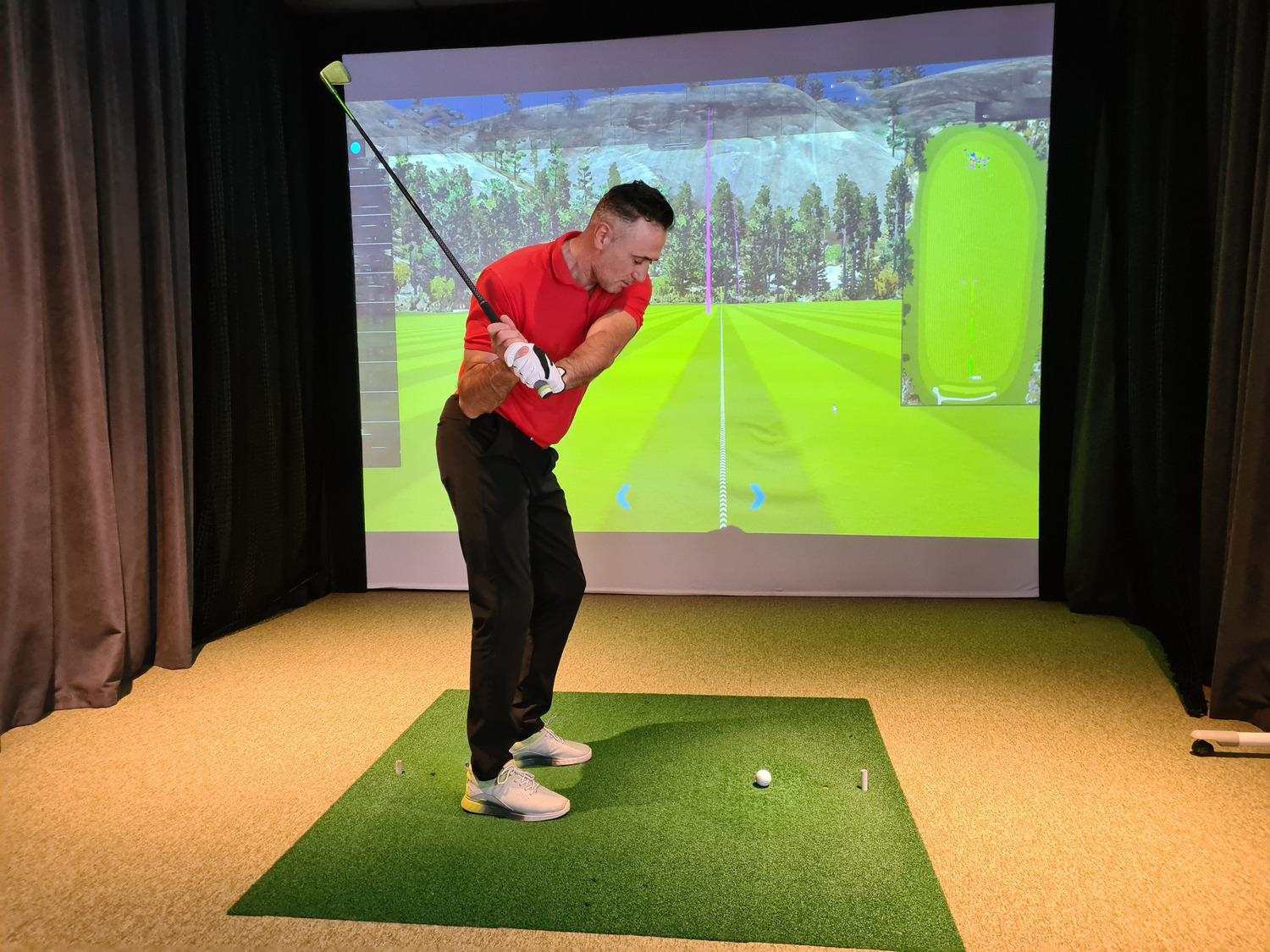
Buying the wrong enclosure size is one of those mistakes you only make once—and it's expensive. Either you're stuck with a setup that barely fits, you're ducking on your backswing, or you've got a $1,500 enclosure sitting in boxes because it simply won't work in your space. Let's make sure that doesn't happen.
This guide covers everything you need to know to pick the right enclosure for your room, your height, and your equipment. No fluff, just the stuff that actually matters.
Measuring Your Space (Get This Right First)
Before you even look at enclosures, grab a tape measure. The three dimensions that matter: ceiling height, room width, and room depth. Get these wrong and nothing else matters.
Ceiling Height (Usually the Dealbreaker)
Ceiling height is where most home simulators hit their first wall—literally. Here's the reality:
8 feet can work if you're shorter and willing to modify your swing. Forget driver unless you've got a compact backswing. A guy on the forums spent three months with an 8-foot ceiling before giving up and moving his setup to the garage.
8.5 feet is doable for most golfers under 6 feet. You'll feel a bit cramped on the backswing, but it's workable.
9 feet is the sweet spot for most home setups. If you can get 9 feet, do it. Golfers up to 6'2" can swing freely, and you'll stop thinking about the ceiling entirely.
10+ feet is the dream. Full freedom, no restrictions, swing like you're at the range.
Room Width
Width determines positioning flexibility and whether you can accommodate lefties and righties:
Around 10 feet is tight but workable if you're centering everything. You won't have much room to adjust.
12 feet gives you breathing room—enough to offset your position slightly for camera-based monitors.
14+ feet is where you can really work with the space. Left and right-handed golfers, offset positioning for launch monitors, the works.
Room Depth (Depends on Your Launch Monitor)
This one catches people off guard. Your launch monitor choice basically dictates how much depth you need:
12-14 feet works for camera-based systems (SkyTrak, Foresight GC2/GC3, Uneekor). These sit beside or behind the ball, so they don't need much runway.
15-17 feet is what you need for radar-based units (Garmin R10, Mevo+, FlightScope). They sit behind you and need distance to track the ball.
18+ feet is ideal for the high-end radar systems like Trackman or Full Swing. If you're dropping that kind of money on a launch monitor, you probably already have the space.
Projector Throw Distance: The Hidden Space Requirement
Here's something that catches a lot of builders off guard: your projector needs space too, and it directly impacts where your enclosure can sit in the room.
Understanding Throw Distance
"Throw distance" is how far the projector sits from your screen. Different projector types need different amounts of space:
| Projector Type | Distance from Screen | Best For |
|---|---|---|
| Ultra Short Throw | 1-3 feet | Tight spaces, ceiling mount directly above screen |
| Short Throw | 4-6 feet | Most home setups, good balance |
| Standard Throw | 8-12 feet | Dedicated rooms with depth to spare |
The Math That Matters
For a 10-foot wide screen, here's roughly what you need:
- Ultra short throw: 1.5-2 feet from screen
- Short throw (0.5 ratio): ~5 feet from screen
- Standard throw (1.2 ratio): ~12 feet from screen
This distance comes *in addition to* your enclosure depth. If you've got a 10-foot deep enclosure and a standard throw projector, you need roughly 22 feet of total room depth.
Pro Tip: Ceiling Mount Placement
Most people ceiling-mount their projector. That means you need to think about:
- Projector hanging below ceiling level (usually 6-12 inches)
- Enough height clearance so the golfer doesn't hit it on the backswing
- Cable routing to your computer/source
If ceiling height is marginal, an ultra short throw projector mounted just behind the top of the screen can save your setup.
Enclosure Size by Launch Monitor
Your launch monitor isn't just a data device—it dictates your entire room layout. Here's a compatibility breakdown to help you plan:
| Launch Monitor | Type | Min. Room Depth | Min. Ceiling | Notes |
|---|---|---|---|---|
| Garmin R10 | Radar | 15 ft | 8 ft | Budget-friendly, needs space behind |
| SkyTrak | Camera | 12 ft | 8 ft | Compact, sits beside ball |
| Mevo+ | Radar | 16 ft | 8 ft | Great outdoors, needs runway |
| Foresight GC3 | Camera | 12 ft | 8 ft | Premium accuracy, space-efficient |
| Bushnell Launch Pro | Camera | 13 ft | 8.5 ft | Excellent data, moderate space |
| Uneekor EYE XO2 | Overhead | 12 ft | 9.5 ft | Ceiling-mounted, saves floor space |
| Trackman 4 | Radar | 18 ft | 9 ft | Pro-level, needs dedicated room |
| Full Swing KIT | Camera | 14 ft | 9 ft | Ball and club data, mid-size room |
The Bottom Line: If you're space-constrained, start with camera-based monitors. If you've got depth, radar monitors offer excellent value.
Why You Need More Room Than You Think
One of the most common mistakes we see: buying an enclosure that perfectly matches your room dimensions on paper. Then the installer shows up and realizes there's literally no room to assemble the frame.
Buffer Zones That Actually Matter
Ceiling buffer (2-3 inches minimum): Your ceiling probably isn't perfectly level. Enclosure frames need room to attach. Give yourself the margin.
Side buffers (3-6 inches per side): You need access to install the enclosure, and you don't want the frame touching your walls. Trust us on this one.
Rear buffer (8-12 inches): Balls deflect. Screen tension systems need space. Your projector might be back there too.
Front buffer: Your hitting mat, plus 2-3 feet behind where you stand. People forget this and end up with their heels against the wall.
How Tall Are You? (It Actually Matters)
Your height directly impacts the ceiling you need. Here's what we generally see work:
Under 5'8": An 8-foot ceiling can work, but you'll probably modify your swing somewhat. Many golfers in this range report being comfortable after adjusting.
5'8" to 6'0": 8.5 feet is your minimum, but 9 feet makes a noticeable difference in how freely you swing.
6'0" to 6'2": You really need 9 feet. Anything less and you'll be thinking about the ceiling every time you take the club back.
Over 6'2": 9.5 to 10 feet is what you're after. One builder on the forums is 6'4" and says anything under 10 feet feels claustrophobic.
Do the Swing Test Before You Buy
Stand in your space with your driver. Take a full backswing (don't swing through—we're not responsible for ceiling damage). Have someone measure from the club head to the ceiling. Add 6 inches for safety. That's your real clearance requirement.
Aspect Ratio: Which Shape Works for Your Room?
Screens come in different shapes. Here's how to pick:
4:3 (More Square)
This maximizes height in rooms with limited ceiling space. Works great in 10-12 foot wide rooms. Some older projectors and simulator software prefer this ratio.
16:9 (Widescreen)
The modern standard—matches most projectors. You'll want 14+ feet of width to make this work well. Better peripheral vision, more immersive, but needs the space.
16:10 (In Between)
A solid middle ground. Native ratio for many business-grade projectors. Slightly more height than 16:9, which can help in marginal ceiling situations.
Launch Monitor Compatibility
Your launch monitor choice shapes your entire room layout. Here's the breakdown:
Camera-Based Systems (SkyTrak, Foresight, Uneekor)
These sit beside or behind the ball, so they're your best friend in tighter spaces. You can work with 12-14 feet of total room depth. The tradeoff? They're generally pricier, but if space is limited, that's the direction you're going.
Radar-Based Systems (Garmin R10, Mevo+, FlightScope)
These sit 6-8 feet behind you, so you need 15-17+ feet of depth. More affordable entry point for many golfers, but they're pickier about space.
Overhead-Mounted (Uneekor EYE XO2, Foresight GCHawk)
These mount to the ceiling, so you need 9-10 feet of height minimum—but they don't eat any floor space. Worth considering if you've got the ceiling but not the depth.
Where Most People Build
Garage Setups (The Most Popular Choice)
Most 2-car garages give you 8-9 foot ceilings, 18-20 feet of width, and 20+ feet of depth. That's workable.
Watch out for garage door opener rails—they can steal 6-12 inches of ceiling height right where you need it. One builder raised his garage door tracks 8 inches and went from "can't swing a 7-iron" to "comfortable with everything but driver."
Concrete floors are great for stability but brutal in winter. Plan for climate control if you're somewhere cold. Most garage builds end up with a 10x10 or 12x10 enclosure.
Thinking about a garage build? Check out our complete Garage Golf Simulator Guide for detailed planning tips, climate control options, and retractable enclosure considerations.
Basement Installations
Basements usually have 7-8 foot ceilings, which is limiting but not a dealbreaker. Measure to the bottom of any ductwork or beams—that's your real ceiling.
Hunt for the area with maximum clearance. You might be looking at a compact 8x10 enclosure. The upside? Basements are usually climate-controlled already.
For more on room planning fundamentals, see our Golf Simulator Room Size Guide.
Spare Bedrooms
Standard 8-foot ceilings with 10-12 foot widths. Width is usually the limiting factor here. You're probably looking at camera-based launch monitors and a compact setup.
If depth is limited, consider a net return system so you're not chasing balls.
Dedicated Rooms
If you're building new or converting a space specifically for golf, aim for 10x16x20 feet minimum (height x width x depth). Plan HVAC placement early. Run electrical for the projector, computer, and launch monitor. Install rubber or turf flooring over concrete.
Quick Reference: Matching Room to Enclosure
Compact (8x10 enclosure)
Room needed: around 10x12x8 feet minimum. Good for budget builds, camera-based monitors, and shorter golfers. You'll probably limit driver use, but for iron practice and short game work, it's perfectly fine. Many people start here and never feel the need to upgrade.
Standard (10x10 enclosure)
Room needed: around 12x14x9 feet minimum. This is where most home builds land. Works with all launch monitor types. It's the sweet spot for price and performance.
Wide (12x10 enclosure)
Room needed: around 14x18x9 feet minimum. Full experience territory. Radar monitors, multiple golfers, room to breathe. This is what serious players typically build.
Premium (14x10 enclosure)
Room needed: around 16x20x10 feet minimum. Commercial-grade or dedicated spaces. Maximum immersion and flexibility, but you need a big room to make it work.
Not Sure What Fits Your Space?
Skip the guesswork. Our [Build Wizard](/wizard) walks you through your exact room dimensions, budget, and preferences—then recommends the right enclosure, screen, and launch monitor for your situation. Takes about 3 minutes and saves hours of research.
Mistakes We See All the Time
Buying Too Large
An enclosure that's too big won't install properly. You'll need professional help at best, and at worst you'll have an unsafe setup or boxes in your garage. Always subtract your buffer space from room dimensions before selecting a size.
Ignoring Ceiling Obstructions
Light fixtures, ceiling fans, smoke detectors, HVAC vents—they all reduce usable ceiling height. Map everything before you measure. One builder bought based on his "9-foot ceiling" only to discover a duct running right through his swing plane.
Forgetting Mat Elevation
A quality hitting mat adds 1-2 inches of height. If you're borderline on ceiling clearance, this can push you over the limit.
Not Testing Your Swing
Paper measurements don't account for your actual swing. Always test in the space. Stand there with a club. Take some practice swings. You'll know pretty quickly if it feels cramped.
Overlooking Projector Throw Distance
Your enclosure depth affects where the projector goes. Short-throw projectors need 4-6 feet from the screen. Standard throw projectors need 8-12 feet. Make sure you have room for both the enclosure and the projector.
The Real Talk Section
Here's what nobody tells you: most people overthink enclosure size. If you've got 9 feet of ceiling and 12 feet of width, you're going to be fine with a standard 10x10. Don't let analysis paralysis keep you from actually building.
The goal isn't the biggest enclosure—it's the best-fitting enclosure for your space. A properly installed compact setup beats a crammed premium setup every time.
Next Steps
Ready to find the perfect enclosure for your space?
- Use our Build Wizard to get personalized recommendations based on your room dimensions
- Browse our Enclosures to compare options
- Check out Launch Monitors to match your monitor to your space requirements
- Compare Screens & Impact Screens for your enclosure
- Need software recommendations? See our Golf Simulator Software Comparison
If you're on the fence between two sizes, go smaller. You can always upgrade later—but you can't make your ceiling higher.
Related Guides
Bullseye 3D Golf Mat Review (2026): The New Budget Divot-Feel Mat
Read our Bullseye 3D golf mat review to see how it handles joint shock, launch monitor accuracy, and long-term durability. Learn if it fits your sim setup.
Uneekor EYE XR Review (2026): Overhead Launch Monitor for Home Sims
Read our honest Uneekor EYE XR review covering accuracy, room space requirements, GSPro costs, and whether this overhead launch monitor fits your home setup.
Rapsodo CLMPRO: First Look at the Overhead Six-Camera Launch Monitor
Wondering if the Rapsodo CLMPRO is worth waiting for? Explore confirmed prototype specs, ceiling clearance needs, GSPro compatibility, and ownership costs.