
Bullseye 3D Golf Mat Review (2026): The New Budget Divot-Feel Mat

Bullseye 3D Golf Mat Review (2026)
If you are building on a budget, getting realistic divot feel and joint protection without premium prices is tough. This Bullseye 3D golf mat review tests whether this insert delivers safe strikes, clean launch monitor reads, and true three-year value.
The catch: 3D turf can feel firmer, and long-term durability remains unproven. Here is where it fits against the best hitting mat field, starting with impact feel and joint stress.
Impact Feel and Joint Safety: How the Bullseye 3D Handles Heavy Strikes
When you hit 100 or more balls in a single session, mat feel stops being a preference and becomes an injury variable. Repeatedly striking turf over a concrete garage floor will wreck your lead elbow, wrists, and shoulders if the surface bounces the club or bottoms out hard.
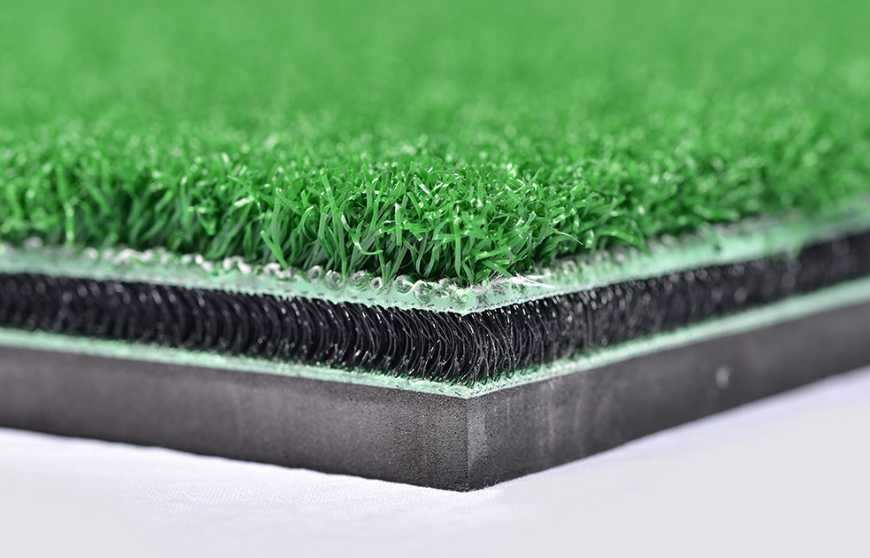
The Bullseye 3D addresses this with a three-part build. Beneath the top woven nylon turf sits an internal compressible vertical fiber layer bonded to a dense foam base. That middle layer compresses during impact, giving the leading edge room to travel downward rather than rebounding violently off a rigid subfloor.
In testing for this Bullseye 3D golf mat review, how that layer performs comes down to your angle of attack:
- Shallow and sweeping strikes: Picking the ball clean or brushing the turf feels crisp and stable. The surface does not grab the hosel, and the clubhead travels through without artificial bounce.
- Steep wedge strikes: Dig hard with a wedge and you quickly find the limits of the compressible fibers. While it dampens shock far better than flat range turf on concrete, steep strikes bottom out early and send noticeable vibration up the steel shaft.
- Where it sits on the spectrum: The Bullseye 3D is far more forgiving than dense, grabby options like Country Club Elite. However, it feels noticeably firmer at impact than grass-panel systems like Fiberbuilt or foam-drop inserts like the Holy Grail.
The known weakness: The Bullseye 3D is a firmer-feeling 3D-style insert. It provides decent cushion, but it is not soft enough to be a true joint-safe solution for golfers already managing wrist tendonitis or golfer's elbow.
If you are a steep digger or a high-volume player, joint comfort is a pass-or-fail test. Sweepers will appreciate the realistic, non-bouncing feedback, but steep swingers nursing joint pain should check our guide to the best hitting mats for a golf simulator for softer alternatives.
Launch Monitor Accuracy: How the Bullseye 3D Impacts Your Numbers
Your hitting surface is an active part of your measurement system. If a mat bounces the clubhead into the ball on a heavy strike, your launch monitor data stops reflecting your swing and starts measuring your turf. In any honest Bullseye 3D golf mat review, tracking accuracy comes down to two strike interactions:
- Fat-shot realism: Cheap mats bounce the sole forward, turning fat strikes into artificially clean launches with inflated ball speed. The Bullseye 3D compresses downward better than basic commercial turf, giving you noticeable feedback on heavy hits. However, the firm base still lets a chunked iron get away with less ball speed loss than real fairway sod.
- Spin realism: Grabby turf pinches the ball and chokes the grooves, creating unpredictable spin decay. Flush strikes off the Bullseye 3D produce consistent spin windows through mid-irons and wedges because the nylon fibers allow clean clubface contact without grabbing early.
If you run a side-mounted photometric unit like a SkyTrak+ or Bushnell Launch Pro, watch your vertical alignment. These camera units are sensitive to ball height and hitting zone level. If the Bullseye 3D sits higher than your stance floor, the ball rests elevated relative to the optical lens. You will need leveling shims or a recessed cutout to keep the monitor flush with the hitting surface.
Long-term quantitative launch monitor datasets for this mat remain scarce, with most community consensus relying on early impressions. To validate it yourself, hit 10 centered 8-irons followed by 10 intentionally heavy strikes with the same ball. A realistic mat should show a clear 12 to 18 mph drop in ball speed on fat contact rather than masking the miss.
This matters most if you practice wedge spin indoors or run side-mounted cameras. If you are still mapping out your tech, check our guide on what launch monitors work with GSPro to understand how different tracking engines interact with your hitting zone.
Stance Integration and Setup: Getting the Bullseye 3D Flush on Concrete
A great hitting strip installed poorly quickly becomes a bad mat. If your stance surface sits lower than the ball, your posture shifts, your low point changes, and launch monitors struggle with alignment. For any Bullseye 3D golf mat setup, getting the insert truly flush with your feet is a mechanical requirement, not a cosmetic one.
First, match insert sizing to your launch monitor hitting zone. A standard compact strip works for single-sided garage bays, while a wider centered insert is essential if you host both right- and left-handed golfers without shifting the platform.
Stance integration typically follows one of two paths:
- Recessed subfloor cutout: Build a stance deck with 3/4-inch or 1-inch interlocking EVA foam tiles and cut a precise pocket for the strip. This locks the hitting surface dead flush with your standing area.
- Drop-in stance alignment: If placing the insert beside an existing stance mat, measure total thickness first. Shim under the stance mat if the Bullseye 3D sits taller, or shim underneath the strip with rigid plastic sheets if it sits lower.
Never set the strip directly on a bare concrete garage floor. Underlayment such as high-density gym foam dampens joint shock and prevents the insert from bottoming out on steep iron strikes. Anchor the underside with heavy-duty carpet tape or Velcro. Without it, rotational swing force causes the insert to creep forward shot after shot.
Finally, calculate vertical height stack-up. A subfloor plus a thick mat can eat two inches of room height, which often decides whether you can swing driver safely in a low basement. Check your clearance against the minimum golf simulator ceiling height before locking in your subfloor build. This setup step matters most for garage builds over raw concrete and basements where every inch counts.
Total Cost: The True Three-Year Price of a Bullseye 3D Setup
Budget buyers often get burned by treating a hitting strip as a complete hitting solution. The sticker price looks cheap on day one, but piecemeal accessories and premature wear can quietly erase your savings over time.
To understand the real numbers in this Bullseye 3D golf mat review, you have to look beyond the insert itself:
- The strip itself: Prices range from roughly $80 to $150 depending on whether you buy a compact 12x30-inch insert or a wider dimension for dual-sided play.
- Platform build components: If you do not own a recessed hitting deck, factor in a dedicated stance mat ($100 to $150), high-density EVA gym underlayment tiles ($30 to $50), and carpet tape or heavy-duty Velcro ($15 to $20).
- Replacement economics: The top turf and vertical fibers take the brunt of every swing. Repeated iron strikes cause the compressible layer to fatigue long before the base gives out.
When you map this out over three years, two realistic financial scenarios emerge:
- Casual user (1 to 2 sessions per week): One strip ($100) plus a DIY foam and stance deck ($150) easily survives three full seasons without structural breakdown. Total 3-year spend: ~$250.
- High-volume simulator golfer (4+ sessions per week): Heavy iron play will pack down the impact zone within 12 to 18 months. Factoring in one or two replacement strips, your 3-year outlay lands between $350 and $450.
The Bullseye 3D makes financial sense if you are willing to build your own platform and prefer spending $100 on modular replacements rather than dropping $600 to $1,000 upfront on a Fiberbuilt or SIGPRO Softy system. If you want out-of-the-box stance integration with proven drop-in longevity, paying more for a Holy Grail setup carries far less DIY frustration. For a broader look at sim budgeting, see our complete golf simulator total cost breakdown.
The Verdict: Is the Bullseye 3D Golf Mat Worth It?
To wrap up this Bullseye 3D golf mat review, the bottom line comes down to swing mechanics. It is an effective, budget-friendly hitting strip that provides genuine downward compression for shallow strikers, but its firmer base makes it a risky choice if you need maximum joint protection.
| Category | Judgment | Takeaway |
|---|---|---|
| Divot feel and joint protection | Fair | Cushions shallow strikes cleanly, but steep contact bottoms out into dense foam and sends shock up the shaft. |
| Launch monitor interaction | Good | Delivers reliable spin and launch reads on camera units, though fat misses are penalized less than on real grass. |
| Fit, height, and install practicality | Good | Drops cleanly into standard 1.75-inch foam stance decks, but needs carpet tape or borders to prevent forward slide. |
| Total cost and 3-year value | Excellent | Low initial price and affordable drop-in replacement strips keep your total 3-year investment well under $250. |
Buy It If
- You want an affordable divot-action insert to drop into a custom EVA foam platform.
- You have a neutral or shallow angle of attack and pick the ball cleanly off the turf.
- You can commit to a flush installation and your wrists, elbows, and lead shoulders are completely healthy.
Look Elsewhere If
- Joint protection and impact cushioning are your absolute top priorities in a sim build.
- You are a steep digger who drives the clubhead aggressively down through the ball.
- You prefer driving real wooden tees directly into the hitting surface without using specialized rubber holders.
- You require multi-year, community-proven durability testing before spending money on an insert.
Bullseye 3D vs Holy Grail
If you are cross-shopping the Bullseye 3D against the Holy Grail, the decision hinges on mechanical design and impact forgiveness. The Holy Grail uses a polycarbonate sheet suspended over open air that physically drops away from the clubhead on strike. That design provides superior shock relief for your joints, but it comes at the expense of a slightly artificial feel underfoot.
The Bullseye 3D relies on compressible vertical fibers over dense backing foam. It feels firmer, more stable, and closer to fairway turf, but it transmits significantly more impact shock when you miss heavy.
Before buying, measure your planned stance deck cutout and calculate your total height stack-up to confirm you can mount this strip dead flush with your standing turf. An unlevel hitting strip causes swing compensation and accelerates edge wear. If you take deep divots or have a history of golfer's elbow, skip firm foam inserts entirely and review softer options in our guide to the best hitting mats for a golf simulator.
Frequently Asked Questions: Bullseye 3D Golf Mat
Is the Bullseye 3D worth it in 2026 as a budget golf hitting mat option?
Yes, the Bullseye 3D is worth the $80 to $150 price tag if you want an affordable insert for a custom stance deck and swing with a shallow angle of attack. It delivers functional divot action without distorting launch monitor numbers, provided you take the time to mount it flush with your standing surface. However, if you are a steep digger or need out-of-the-box joint relief without building a DIY platform, spending more on a dedicated commercial mat is the smarter move.
Bullseye 3D vs Holy Grail: which is better for golfers elbow or wrist pain?
The Holy Grail is significantly better if you already suffer from golfer's elbow, wrist tendonitis, or chronic joint pain. Its drop-down polycarbonate plate physically yields away from the clubhead on steep strikes, absorbing the shock that dense turf sends straight up your arms. The Bullseye 3D compresses vertical fibers, but realistic divot feel is not the same thing as joint safety. Steep strikes on the Bullseye will still bottom out into dense foam.
Does the Bullseye 3D punish fat shots realistically?
Yes, the Bullseye 3D penalizes fat shots reasonably well by dropping ball speed and carry distance, though it remains slightly more forgiving than real fairway sod. Because the vertical fibers compress downward, the clubhead does not bounce aggressively forward into the ball like it would on cheap range turf. To verify this at home, hit ten flush mid-irons followed by ten intentionally heavy strikes with the same ball. You should see an immediate 12 to 18 mph drop in ball speed on fat contact.
Can hitting mat height mess with side-mounted photometric launch monitors?
Yes, an unlevel hitting strip will distort ball data on camera-based launch monitors like the SkyTrak+ or Bushnell Launch Pro. Side-mounted optical units require the ball to rest on the exact same horizontal plane as the monitor base to track vertical launch angle and spin axis accurately. Always install your hitting strip flush with your stance deck, measure total stack height, and shim the launch monitor base until it sits level with the turf surface.
How long does a Bullseye 3D hitting strip last?
Expect roughly 12 to 18 months of regular use from a Bullseye 3D strip before the impact zone requires replacement, though long-term community durability data is still limited. High-volume practice will eventually pack down the internal compressible fibers. Watch for clear end-of-life signs: permanent turf dishing in your primary strike area, seam separation from the base foam, tearing fibers, or sudden joint harshness on centered strikes.
Related Guides
Uneekor EYE XR Review (2026): Overhead Launch Monitor for Home Sims
Read our honest Uneekor EYE XR review covering accuracy, room space requirements, GSPro costs, and whether this overhead launch monitor fits your home setup.
Rapsodo CLMPRO: First Look at the Overhead Six-Camera Launch Monitor
Wondering if the Rapsodo CLMPRO is worth waiting for? Explore confirmed prototype specs, ceiling clearance needs, GSPro compatibility, and ownership costs.
Bushnell LPi Review (2026): Bushnell's New Launch Monitor
Our Bushnell LPi review breaks down accuracy, software fees, and bay setup. Find out if this budget indoor launch monitor is worth the recurring costs.