
Square Golf Omni vs Rapsodo MLM2PRO (2026): Best Budget Pick?

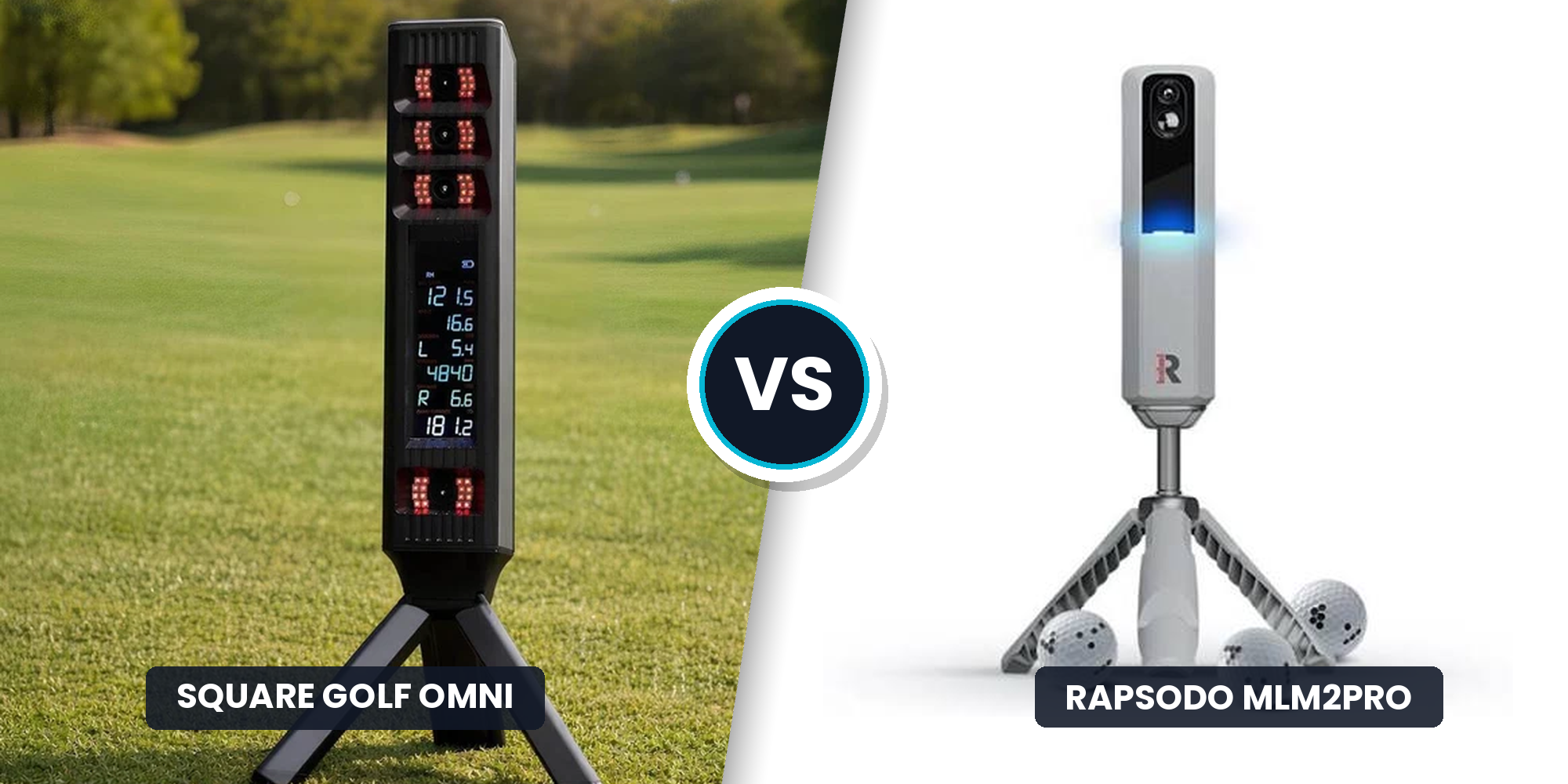
Square Golf Omni vs Rapsodo MLM2PRO (2026): Which Should You Buy?
If you are researching the best launch monitors under $1,000, the Square Golf Omni vs Rapsodo MLM2PRO decision comes down to room depth and subscription tolerance.
The Omni wins if you have tight indoor space or hate recurring fees. The MLM2PRO wins for range portability and polished mobile software, provided you accept its annual subscription and driver-spin caveats.
Here is how their accuracy by club type, space math, and 3-year costs compare.
Accuracy: Driver, Iron, and Spin Measurement Compared
If you are building a home golf simulator, the real cost of buying an inaccurate launch monitor is not missing a carry distance by five yards. It is buying into an ecosystem that feeds you faulty data, leading to phantom swing fixes that ruin your real-world game.
When looking at the Square Golf Omni and the Rapsodo MLM2PRO, both deliver impressive numbers for the sub-$1,000 category. But because they use fundamentally different tracking technologies, their strengths and failure points show up in very different places.
Square Golf Omni: Indoor Optical Strengths
The Square Golf Omni uses a high-speed camera system placed next to the hitting zone. Because it reads the ball immediately at impact, it does not need a long flight window to capture launch angle, ball speed, and initial spin axis.
- Tight-space consistency: In compact indoor setups where ball flight is limited to 8 to 10 feet into a net, optical systems naturally hold an edge over radar.
- Short game and putting: Camera-based tracking excels at picking up low-speed chips and putts that radar units often miss or miscalculate entirely.
- Early benchmarks: Initial testing against commercial-grade reference units shows strong agreement on ball speed and backspin numbers across irons and woods.
The catch with the Omni is not a baseline reading error. It is long-term validation. As a newer platform in the market, it lacks the multi-year community testing and established customer support track record that older brands offer.
Rapsodo MLM2PRO: Proven Irons with a Known Driver Flaw
The MLM2PRO uses a camera plus radar hybrid engine placed behind the golfer. Its iron and wedge accuracy is the reason it built such a loyal following in the simulator community.
- Iron and wedge precision: For mid-irons down to wedges, ball speed, carry, and launch angles track closely with high-end launch monitors.
- RPT ball requirement: To get measured backspin and spin axis instead of calculated estimates, you must use Rapsodo Callaway RPT balls or RPT dot pattern stickers.
- The driver weakness: Driver accuracy is the main community-documented flaw detailed in our Rapsodo MLM2PRO review. The unit frequently struggles with high ball-speed driver readings, tending to miscalculate driver spin and inflate or penalize carry distance.
The Accuracy Verdict
This criterion does not produce a single winner, because the better choice depends on your space and practice habits.
If your primary focus is a compact indoor simulator where you want reliable driver and short game data without needing 14 feet of room depth, the camera-based Square Golf Omni is the safer tool.
If you want a thoroughly field-tested ecosystem with reliable iron and wedge baselines, and you are comfortable treating driver spin numbers as an approximation, the MLM2PRO remains a proven pick.
Space Requirements: Room Depth and Setup Workflow Compared
For most home golf simulator builds, room dimensions are the real first filter. You can love a launch monitor's feature set or price tag, but if your room cannot accommodate its tracking math, the device is a non-starter.
To calculate your true room depth requirement, use this simple formula:
Total Depth = Clearance Behind Ball + Ball-to-Screen Flight Distance + Buffer Behind Screen
When evaluating the Square Golf Omni vs Rapsodo MLM2PRO, physical footprint and positioning create two completely different room requirements and playing workflows.
For a broader breakdown of height, width, and depth standards across different hardware setups, check our complete guide to golf simulator room size and depth planning.
Square Golf Omni: Compact Room Depth with a Placement Catch
The Square Golf Omni is a side-mounted camera system. It sits roughly a foot outside your hitting strip, parallel to the ball, rather than behind the golfer.
- Shorter room footprint: Because the Omni sits alongside the ball, required clearance behind the tee is zero feet. You only need enough space behind the golfer to swing a club safely without hitting the back wall.
- Realistic depth minimums: A tight setup requires roughly 10 to 11 feet of total depth, which breaks down to 1 foot behind the screen, 7 to 8 feet of ball flight, and 2 feet for the golfer. A comfortable setup sits around 12 to 14 feet.
- The mixed-handed tradeoff: Because it sits on one side of the hitting zone, playing with both right-handed and left-handed golfers requires physically picking up the unit, placing it on the opposite side, and recalibrating the hitting box.
Rapsodo MLM2PRO: Radar Depth Demands with Better Session Flow
The MLM2PRO is a radar-hybrid unit that sits directly behind the player on the target line.
- Demanding depth math: The MLM2PRO requires 6.5 to 8.5 feet of clear space behind the ball to track club delivery, plus a minimum of 8 feet of ball flight to the screen. Factoring in a 1-foot screen buffer, you need 15.5 to 17.5 feet of usable room depth.
- Alignment sensitivity: Squeezing the MLM2PRO into a 12-foot room by cutting down ball flight degrades tracking quality immediately, causing dropped shots and erratic spin data, especially on driver.
- Seamless lefty/righty play: Because the unit tracks down the center target line behind the hitting zone, right-handed and left-handed golfers can share a hitting mat without touching or recalibrating the hardware.
The Space Verdict
This space comparison comes down to usable room depth first and group dynamics second.
If your usable room depth is under 15 feet, the Square Golf Omni wins by necessity. It physically fits basements and spare bedrooms where radar units cannot function properly.
If you have 16 or more feet of depth in a garage bay and regularly host mixed-handed groups with both lefties and righties, the MLM2PRO offers a far smoother day-to-day workflow.
Software Compatibility and 3-Year Total Cost of Ownership
The core rule of building a home simulator is simple: choose your software first, then pick hardware that supports it. When evaluating what launch monitors work with GSPro or E6 Connect, your hardware selection dictates your recurring annual subscription bill.
A $699 sticker price means very little if keeping the device functional costs hundreds of dollars in locked software tiers and consumable balls.
Compatibility and Platform Friction Compared
Both devices run third-party software, but they handle ecosystem access and connection stability differently:
- Square Golf Omni: Connects to its native driving range app with no mandatory annual fee. For virtual course play, the native app uses a credit-based model where you buy credits per 18-hole round. It links to GSPro and E6 Connect via connector bridges, letting PC users bypass recurring hardware subscription gates entirely. Setup friction is minimal, though running GSPro requires a dedicated Windows gaming PC.
- Rapsodo MLM2PRO: Integrates with its native app, E6 Connect, and community-developed GSPro connector bridges. However, Rapsodo locks third-party connector access and advanced shot metrics behind its proprietary Premium Membership. You also deal with a "two-app handshake" during setup, running the Rapsodo mobile app on a phone or tablet while routing data across your local network to the PC.
The True 3-Year Total Cost of Ownership (TCO)
To see the real financial picture, you must evaluate hardware, subscriptions, consumable RPT balls, and PC hardware over three full years.
| Cost Component | Square Golf Omni | Rapsodo MLM2PRO |
|---|---|---|
| Hardware Purchase Price | $799 | $699 |
| Mandatory Device Subscriptions (3 Years) | $0 | $198 *(Year 1 included, $99/yr after)* |
| Consumables (Specialty Pattern Balls) | $0 *(uses standard balls)* | $140 *(2 dozen Callaway RPT balls)* |
| Practice-Only 3-Year TCO | $799 | $1,037 |
| GSPro Software (3 Years @ $250/yr) | $750 | $750 |
| Mid-Tier Gaming PC (GPU budget) | $1,000 | $1,000 |
| Full GSPro Sim 3-Year TCO | $2,549 | $2,787 |
*Note: Pricing reflects early 2026 manufacturer rates. Always verify current software subscription tiers and bundled promotion terms before buying.*
The Software and Cost Verdict
This comparison splits cleanly based on your subscription tolerance and primary software target.
The Square Golf Omni wins on long-term cost efficiency. With zero mandatory hardware subscriptions and no requirement for patterned balls, it offers the lowest ongoing friction for golfers building a dedicated GSPro PC simulator.
The Rapsodo MLM2PRO favors golfers who prioritize an all-in-one mobile practice tool over a dedicated PC build. If you value dual-camera video swing replay on an iPad and do not mind the $99 annual fee, the mature Rapsodo app delivers a polished phone-and-tablet experience right out of the box.
The Verdict: Square Golf Omni vs Rapsodo MLM2PRO
The Square Golf Omni and Rapsodo MLM2PRO are not interchangeable budget launch monitors. They optimize for fundamentally different constraints.
The Omni prioritizes compact room geometry and zero mandatory recurring hardware fees. The MLM2PRO delivers a portable radar-camera platform backed by a mature mobile app ecosystem and years of community testing data.
If You Have a Tight Indoor Space: Square Golf Omni
Choose the Square Golf Omni if your usable room depth is under 15 feet. Room depth is a non-negotiable physical gate. Because the photometric Omni sits beside the ball rather than behind you, it functions comfortably in 10 to 12 feet of total room depth. The tradeoff to accept is session workflow: if you regularly host both right-handed and left-handed golfers, you must physically move and recalibrate the unit between players.
If You Split Time Between Indoors and the Driving Range: Rapsodo MLM2PRO
Choose the Rapsodo MLM2PRO if you want a grab-and-go practice tool for the outdoor range. Its form factor, internal battery, and dual-camera swing capture are purpose-built for outdoor practice bays, letting you record video aligned with shot data on your phone or tablet. Just remember that when you bring it inside, you need at least 15.5 to 17.5 feet of total depth for accurate radar tracking.
If You Want to Optimize Long-Term Cost: Square Golf Omni
Choose the Square Golf Omni if you are building a PC-based simulation setup and want to avoid ongoing subscription fees. With no mandatory annual subscription and the ability to use standard golf balls, the Omni saves you roughly $340 over three years compared to the MLM2PRO. For golfers connecting directly to GSPro on a gaming PC, it represents the cleanest long-term financial path under $1,000.
If You Prioritize Polished Mobile Training and Iron Data: Rapsodo MLM2PRO
Choose the Rapsodo MLM2PRO if you want a proven training app with video swing analysis right out of the box. Its iron and wedge accuracy is verified by extensive community testing, and its target combines are excellent for structured practice. Buy it with your eyes open to its weak points: high-speed driver spin remains inconsistent, and you must pay $99 per year after year one to maintain simulator access.
What to Do Next
To finalize your setup without buyer remorse, follow these three steps:
- Measure your room depth: If you have less than 15 feet of total depth from the back wall to the impact screen, buy the camera-based Omni.
- Choose your software path: Decide whether you want a standalone mobile app setup on an iPad (MLM2PRO) or a dedicated PC simulator build (Omni).
- Calculate your 3-year outlay: Check our golf simulator total cost breakdown to account for computers, hitting mats, and ongoing subscriptions before locking in your hardware.
Frequently Asked Questions
Is the Square Golf Omni more accurate than the MLM2PRO?
- The Square Golf Omni provides more consistent driver and short-game data, while the MLM2PRO delivers equal accuracy on mid-irons and wedges.
- The MLM2PRO has a community-documented weakness with driver spin readings at higher ball speeds, leading to occasional carry distance errors.
- The optical Omni measures launch and spin cleanly indoors off the tee, but it is a newer platform with less long-term community testing data than the Rapsodo.
Do I need a subscription to use GSPro with the MLM2PRO?
- Yes, connecting the MLM2PRO to third-party software like GSPro requires Rapsodo's Premium Membership ($99 per year after the included first year).
- GSPro requires its own separate $250 annual subscription, along with a dedicated Windows gaming PC.
- Factoring in hardware, memberships, consumable balls, and a PC build, running GSPro on the MLM2PRO carries a realistic 3-year cost of around $2,787.
How much room depth do I need for Omni vs MLM2PRO?
- The Square Golf Omni requires 10 to 12 feet of usable depth, while the Rapsodo MLM2PRO demands 15.5 to 17.5 feet.
- The Omni sits beside the ball and requires no clearance behind the player, whereas the MLM2PRO needs 6.5 to 8.5 feet of radar tracking space behind the tee.
- While room depth is the primary hardware filter, make sure to also check the minimum ceiling height for a golf simulator so you have enough clearance for full driver swings.
Do I need special balls with the MLM2PRO?
- Yes, the MLM2PRO requires Callaway RPT balls or official dot pattern stickers to measure true backspin and spin axis.
- Hitting standard unmarked golf balls forces the unit to calculate and estimate spin rather than reading it directly.
- Standard golf balls work with the Square Golf Omni out of the box, while MLM2PRO owners need to budget roughly $70 per year for replacement RPT ball packs as the covers scuff.
Is the Omni really 'no subscription'? What are credits?
- Yes, the Square Golf Omni has zero mandatory annual subscription fees for driving range practice and standard third-party PC connections.
- For native on-course play, Square Golf uses a pay-as-you-go credit system where you purchase credits per 18-hole round rather than paying a monthly membership.
- If you plan to play courses exclusively through GSPro or use the driving range for practice, you will never need to buy credits or pay ongoing hardware fees.
Which is better for lefty/righty households?
- The Rapsodo MLM2PRO is far better for households that mix left-handed and right-handed golfers.
- Because the MLM2PRO sits directly behind the tee on the central target line, both golfers can hit from the same mat without adjusting the device.
- The Square Golf Omni sits beside the hitting area, requiring you to physically move the unit across the mat and realign the hitting zone whenever players switch sides.
Related Guides
Foresight GC3S vs GC3 (2026): What's Actually Different?
Compare the Foresight GC3S vs GC3 to see differences in software subscriptions, club data, and 3-year costs. Find out if upgrading is worth it for your setup.
FlightScope Mevo Gen 2 vs Mevo+ (2026): Should You Upgrade?
Comparing Mevo Gen 2 vs Mevo Plus? Discover if upgrading is worth the cost, how indoor room depth compares, and whether the new hardware improves accuracy.
TruGolf LaunchBox Review (2026): All-in-One Sim in a Box
Read our in-depth TruGolf LaunchBox review. Discover real-world accuracy, subscription-free E6 Connect courses, space requirements, and total setup costs.